Vietnamese firms see limited impact from new US tariff
The United States' decision to impose a new tariff of 12.5 percent on certain imports from Vietnam is unlikely to have a major immediate impact, largely because many exporters have already reduced their dependence on the U.S. market, according to Vietnamese businesses.
However, industry leaders and analysts caution that the cumulative impact of tariffs and other trade measures should be closely monitored.
Effective July 24, Vietnamese exports to the United States are subject to a new 12.5-percent tariff under Section 301 of the U.S. Trade Act of 1974, representing an increase of 2.5 percentage points from the previous temporary rate.
Tran Thi Khanh Hien, director of research at MB Securities, told Tuoi Tre (Youth) online newspaper that the tariff does not apply to all Vietnamese exports.
A broad range of products, including electronics, machinery, and components, remain exempt.
These categories account for roughly 55 percent of Vietnam's exports to the United States during the first half of 2026, making them the country's largest export segment.
However, several key export industries, including textiles and garments, seafood, wood products, and furniture, are subject to the new tariff.
Hien noted that Vietnamese exporters could face stronger competition as rival manufacturing countries such as Malaysia or Bangladesh receive lower tariff rates.
Even so, she believes the overall outlook for Vietnam's exports remains largely intact.
Vietnam has built a substantial presence in the U.S. market, particularly in the mid-range textile and footwear segments.
Hien said replacing Vietnamese suppliers would not be feasible in the near term.
Should tariffs raise costs, the burden is likely to be shared across the supply chain, including manufacturers, retailers, and American consumers, rather than falling entirely on Vietnamese producers.
Meanwhile, industries that are more easily replaced, such as stone products, steel, and certain furniture items, account for a relatively small share of exports and are therefore unlikely to significantly affect Vietnam's overall export performance.
Manufacturers diversify beyond US
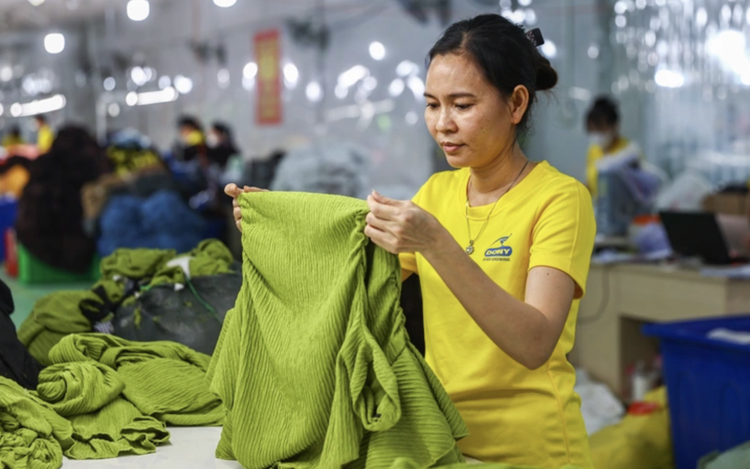
Pham Quang Anh, director of Dony Garment Production Company, said the U.S. market accounted for 60 - 70 percent of the company's production in 2025.
While the large volume of American orders supported stable operations, it also exposed the company to sudden policy shifts involving tariffs, rules of origin, and import requirements.
Rather than continuing to concentrate on expanding sales in the U.S., garment manufacturer Dony began restructuring its market strategy.
Domestic orders, which represented just over 10 percent of revenue in 2025, have increased to more than 25 percent during the first half of this year.
The company has also expanded into Cambodia, Laos, and other Southeast Asian markets.
Following several rounds of restructuring, exports to the United States now account for less than 40 percent of Dony's business.
Anh emphasized that entering new markets involves far more than selling existing products elsewhere.
The company has established new customer relationships while adapting product designs, materials, quality standards, and delivery methods.
"We cannot wait for policies to stabilize before taking action," he said.
The company has maintained stable production by focusing on uniforms, customized products, and higher-value orders.
It has also accelerated automation, increased operational specialization, and renegotiated input costs.
Its revenue rose by some six percent during the first half of the year.
Although profit margins have yet to improve significantly, the company's more diversified customer base has strengthened its resilience.
Steel industry sees limited direct effect
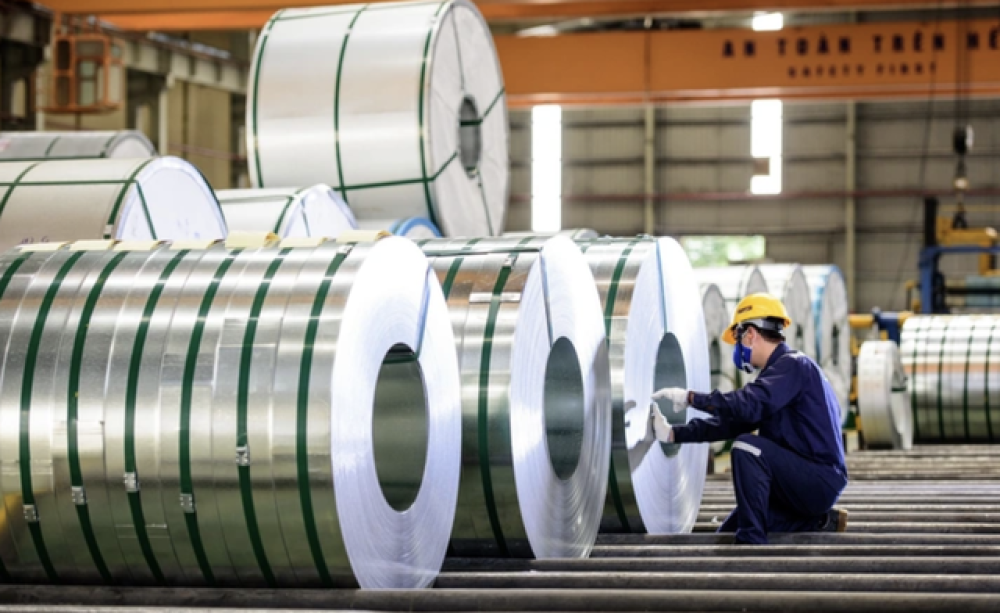
Executives in Vietnam's steel industry expressed little concern over the new U.S. tariff.
“The steel sector is not significantly affected,” a senior executive at one of Vietnam's largest steel companies said, noting that many producers sharply reduced exports to the U.S. roughly two years ago.
Vietnamese steel has long faced multiple trade barriers in the American market, including import tariffs, anti-dumping investigations, countervailing duty cases, and anti-circumvention measures.
The United States had previously imposed a 25-percent tariff on imported steel under Section 232 before later raising it to 50 percent.
Hoa Sen Group stopped exporting coated steel products to the United States in September 2024 and has since expanded sales to more than 90 countries and territories while strengthening its domestic business.
The industry executive warned against assuming that the additional 2.5 percentage-point increase marks the end of U.S. trade restrictions.
Washington could tighten rules of origin, initiate product-specific investigations, or scrutinize raw material sourcing more aggressively.
The steel industry may also experience indirect effects.
If export-oriented sectors such as textiles and wood products receive fewer orders, demand for factories, transportation services, machinery, and industrial materials could weaken.
Meanwhile, exports from countries facing barriers in the U.S. market may be redirected to Southeast Asia, intensifying price competition in Vietnam.
Industries with heavy reliance on the U.S. market including wood products, electronics, textiles, and footwear are expected to face the greatest adjustment challenges.
Despite the challenges, many businesses see the evolving trade environment as an opportunity to diversify export markets and reduce dependence on a single destination.
Vietnamese companies continue to regard the United States as a critical market, but its recent policy uncertainty has prompted them to broaden revenue sources and strengthen long-term growth.
Hien said exporters will also face increasing pressure from overseas buyers to comply with stricter international standards.
Over time, these requirements are expected to improve labor conditions, employee welfare, corporate governance, and Vietnam's overall business environment.
She said that the tariff policy pursued by Washington should be viewed primarily as a negotiating tool aimed at increasing government revenue and reducing the U.S. trade deficit.
High tariff rates are intended to create leverage during trade negotiations rather than represent permanent policy outcomes.
As a result, bilateral negotiations are likely to continue as countries seek more favorable tariff arrangements and trade conditions.
Although the direct impact on exports appears manageable, Hien said that the most significant short-term risk stems from investor sentiment in the stock market.
In periods when financial markets lack supportive information or remain particularly sensitive, tariff-related news can trigger disproportionately negative reactions.
From a longer-term perspective, experts believe increasingly stringent requirements on trade, labor standards, and intellectual property from the United States and other developed economies will encourage Vietnamese companies to strengthen corporate governance, improve product quality, and align operations with international best practices.
Such changes are expected to enhance Vietnam's competitiveness and support deeper integration into global value chains.
Last week, the United States imposed new tariffs of 10 and 12.5 percent on goods from 60 trading partners, including the EU and China, alleging those countries failed to curb imports made by forced labor, just as a temporary 10 percent global tariff expired, Reuters reported.
The move is the White House's first step in efforts to rebuild President Donald Trump's near-global tariff wall after the U.S. Supreme Court in February struck down his ‘reciprocal’ duties of 10 to 50 percent imposed last year under a national emergencies law to try to shrink the U.S. trade deficit.
Source: Tuoi Tre News
Photo: Cong Trieu / Tuoi Tre