Vietnam tested by rising global energy risks
Events in the Middle East are sure to test Vietnam’s long-term energy security strategy.
The global energy system is facing a severe shock following Operation Epic Fury in the Middle East and the blockade of the Strait of Hormuz. The crisis is also emerging as a “stress test” and an opportunity for Vietnam to accelerate a comprehensive, long-term transformation to safeguard energy security.
The concept of energy security in the 21st century has undergone a profound structural shift, moving beyond traditional definitions centered solely on fossil fuel supply. It now encompasses a broader framework built on four core pillars - the “4As”: Availability, Accessibility, Affordability, and Acceptability.
After four decades of transformation from an agricultural economy into a dynamic industrial manufacturing hub and major destination for FDI in Asia, energy security has become the absolute foundation of Vietnam’s growth, directly shaping macro-economic stability and national security.
Energy demand under growth pressure
Achieving the double-digit GDP growth target for 2026-2030 will require vast energy resources, with electricity demand projected to rise by 12-14 per cent annually. Industrialization, digital infrastructure, logistics, and urbanization all depend on stable and affordable energy supplies. Rapid economic expansion has pushed Vietnam’s energy system to a turning point. The country has shifted from being a net exporter of traditional energy to a rapidly-growing net importer.
Macro-economic data shows that Vietnam’s total primary energy consumption reached approximately 1,457.179 terawatt-hours (TWh) in 2024, equivalent to around 126 million tonnes of oil equivalent (Mtoe), with an average annual growth rate of 9 per cent during 2022-2024.
A key structural concern is the overwhelming dominance of fossil fuels, accounting for 78.46 per cent of total consumption. Coal leads with 693.435 TWh (47.58 per cent), followed by oil at 388.967 TWh (26.69 per cent) and natural gas at 60.987 TWh (4.18 per cent). This leaves the economy exposed to significant external risks, particularly as domestic production of coal, oil, and gas has reached technical limits and entered irreversible decline.
Domestic coal output by the Vietnam Coal and Minerals Industrial Group (Vinacomin) has plateaued at around 43-44 million tonnes annually as open-pit mines in Quang Ninh province near depletion. As a result, Vietnam imported more than 11.15 million tonnes of coal in 2024, worth over $1.2 billion, making it one of the world’s Top 5 coal importers.
Oil production peaked in 2004 and has been declining since, creating a structural paradox. Vietnam exports high-value light sweet crude (priced at $561.54 per tonne) but must import more than 2.16 million tonnes of specialized crude (at $501.48 per tonne) for the Dung Quat and Nghi Son refineries. At the same time, it imports over 2.17 million tonnes of refined petroleum products at significantly higher prices of up to $663.65 per tonne.
Cost modeling highlights the disparity: producing 1 TWh of primary energy costs approximately $18.64 million from imported coal, $44.28 million from LNG, and $55.95 million from oil.
Vietnam’s total primary energy bill in 2024 is estimated at $53.65 billion, equivalent to roughly 11.26 per cent of GDP. Of this, $37.39 billion was spent on fossil fuel imports, placing significant pressure on the balance of payments and eroding the country’s trade surplus.
Energy costs also play a central role in inflation transmission. Linear regression models indicate that a 1 per cent increase in total energy costs raises the CPI by approximately 0.2 percentage points. The impact spreads quickly through direct channels such as transport and electricity prices, as well as indirect channels including agricultural inputs and construction materials.
Global shocks and immediate impacts
These structural vulnerabilities became starkly evident from late February to early March, when the global energy system was jolted by Operation Epic Fury in the Middle East. Airstrikes on Iran’s nuclear facilities and subsequent missile retaliation prompted Tehran to declare a blockade of the Strait of Hormuz - a critical maritime chokepoint handling about one-fifth of global oil and LNG flows. Vessel traffic plunged from 153 ships per day to just 13 by March 2, and was nearly halted on March 8-9, sending Brent crude prices soaring from $60-70 per barrel to a peak of $126.
Vietnam, deeply integrated into Asian maritime logistics, felt the macro-economic ripple effects almost immediately. In the first two and a half months of 2026 alone, fuel imports surged to approximately $5.27 billion.
Logistics and rail companies immediately raised fees by 10-15 per cent and shortened quotation validity to 24 hours. International air travel was disrupted, affecting more than 4,400 passengers.
The crisis also undermined the positioning of LNG as a “perfect transition fuel,” exposing the fragility of maritime supply chains under geopolitical shocks. Vietnam Electricity (EVN), already burdened with accumulated losses of VND44.792 trillion ($1.72 billion) as of end-2024, faced acute liquidity pressure as LNG-based power generation costs were projected to exceed VND3,327 ($0.13) per kWh, threatening affordability across the economy.
Short-term response, long-term strategy
Recognizing the inflationary risks and impact on purchasing power and export competitiveness, the government implemented a series of urgent policy measures while accelerating structural energy reforms.
Prime Minister Pham Minh Chinh ordered that energy shortages must not occur under any circumstances and activated emergency fiscal tools through Decree No. 72/2026/ND-CP, effective from March 9 to April 30, 2026.
In a classic macro-economic trade-off, Vietnam temporarily sacrificed fiscal revenue by reducing Most-Favored-Nation (MFN) import tariffs to 0 per cent on key fuels, including gasoline (previously 10 per cent), diesel and aviation fuel (previously 7 per cent), and petrochemical inputs. This enabled importers to source fuel globally without origin constraints.
Price management was also liberalized under Resolution No. 36/NQ-CP, allowing immediate retail price adjustments if base prices fluctuate by 7 per cent or more in a single day, instead of following a fixed weekly cycle.
On the supply side, Vietnam secured approximately 4 million barrels of oil through high-level diplomacy with Kuwait, Qatar, and the UAE. Domestic refineries were pushed to maximum output, with Dung Quat operating at about 118 per cent of capacity. The Law on Petroleum 2022 was also activated to prioritize domestic retention of crude oil and condensate.
While these measures stabilized the market in the short term, the March 2026 crisis demonstrated that fiscal and monetary policy space is finite. The only sustainable solution lies in a comprehensive system transformation outlined in Politburo Resolution No. 70-NQ/TW and the revised National Power Development Plan VIII (PDP8).
Politburo Resolution No. 70 elevates energy security to a pillar of national security, targeting strategic reserves equivalent to 75-80 days of net imports by 2030, rising to 90 days thereafter, requiring tens of billions of dollars in storage and logistics infrastructure.
The transition centers on accelerating renewable and low-emission energy to reduce dependence on external fossil fuel supply chains and avoid carbon-related trade barriers such as the EU’s Carbon Border Adjustment Mechanism (CBAM).
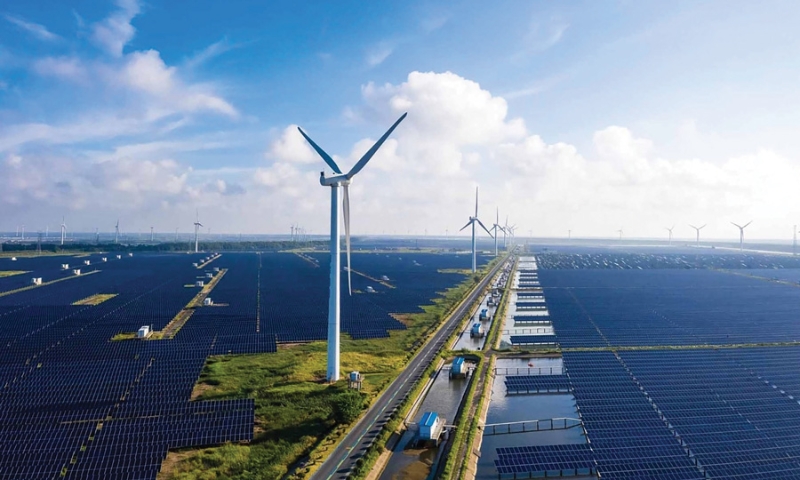
The revised PDP8 targets total installed capacity of 89,655-99,934 MW by 2030, with renewables (excluding large hydropower) accounting for 28-36 per cent, rising to 70 per cent by 2050. The economics are increasingly favorable: Global Levelized Costs of Energy (LCOE) have fallen to around $34 million per TWh for onshore wind and $43 million per TWh for solar; far below imported fossil fuels.
To address intermittency and grid congestion, Vietnam is investing in a large-scale high-voltage direct current (HVDC) transmission network with a capacity of 40,000-60,000 MW, alongside battery energy storage systems (BESS) of 10,000-16,300 MW by 2030.
In a major policy shift, nuclear power is being reintroduced, with Ninh Thuan 1 and 2 expected to provide 4,000-6,400 MW of stable, zero-emission baseload capacity between 2030 and 2035.
Market reforms are also advancing. The Direct Power Purchase Agreement (DPPA) mechanism breaks the single-buyer model, unlocking private green investment, while cross-border grid integration under the ASEAN Power Grid, with projected regional investment of $764 billion, aims to enhance system resilience.
Only through a coordinated strategy, expanding domestic renewables, modernizing grid infrastructure, diversifying legal frameworks, and strengthening system affordability, can Vietnam build a robust macro-economic shield against global geopolitical shocks and secure sustainable prosperity in the 21st century.
Source: Associate Professor Nguyen Dinh Tho